
Mercedes-Benz EQ Range in India: EQS, EQE, EQA, EQB, G580 Compared
Mercedes-Benz's five electric lines in India compared by price, range and battery, from the 857 km ARAI EQS sedan and the 122 kWh EQS SUV to the upcoming EQE and the Rs 3.10 crore G 580.
Mercedes-Benz sells electric model lines in India today, but they are not one family. They share the three-pointed star, the EQ badge, and nothing else that matters on the spec sheet. Prices span ₹67.20 lakh to ₹3.10 crore, battery sizes run from 66.5 kWh to 122 kWh, and this is the part most comparisons skip: two of the five names in this line-up (EQA, EQB) are no longer sold new in India at all, while a third (EQE) actually refers to two completely different cars.
This guide doesn't just list numbers off a brochure. It works out what those numbers cost you every month, what “857 km range” actually means once you turn the AC on in a Mumbai traffic jam, and who should, and shouldn't, write this cheque.

EVSoch Verdict
Verdict Best for: Buyers who want the longest-range, most tech-loaded EV money can buy in India today, and who charge overnight at home rather than depending on public DC networks. Biggest advantage: Nothing else on sale in India gets close to the EQS's ARAI-claimed range, and the running cost is a fraction of an equivalent petrol Mercedes. Biggest concern: Two of the five nameplates people search for (EQA, EQB) can no longer be bought new, and the EQE sedan you may be waiting for has no confirmed India launch date. Who should consider it: High-net-worth buyers with guaranteed home or bungalow charging, not apartment dwellers relying on shared or public infrastructure. |
The EQ range in India at a glance
Model | Price (₹, ex-showroom) | Battery | Range | Power | Status |
EQA 250 Plus | 67.20 L | 70.5 kWh | 560 km (WLTP) | 188 bhp | Discontinued (Apr 2026) |
EQB 250 Plus | 72.20 L | 70.5 kWh | 535 km (WLTP) | 188 bhp | Discontinued (Apr 2026) |
EQE Sedan | ~1.20 Cr (expected) | 90.6 kWh | 639 km (WLTP) | 292 PS | Upcoming, no confirmed date |
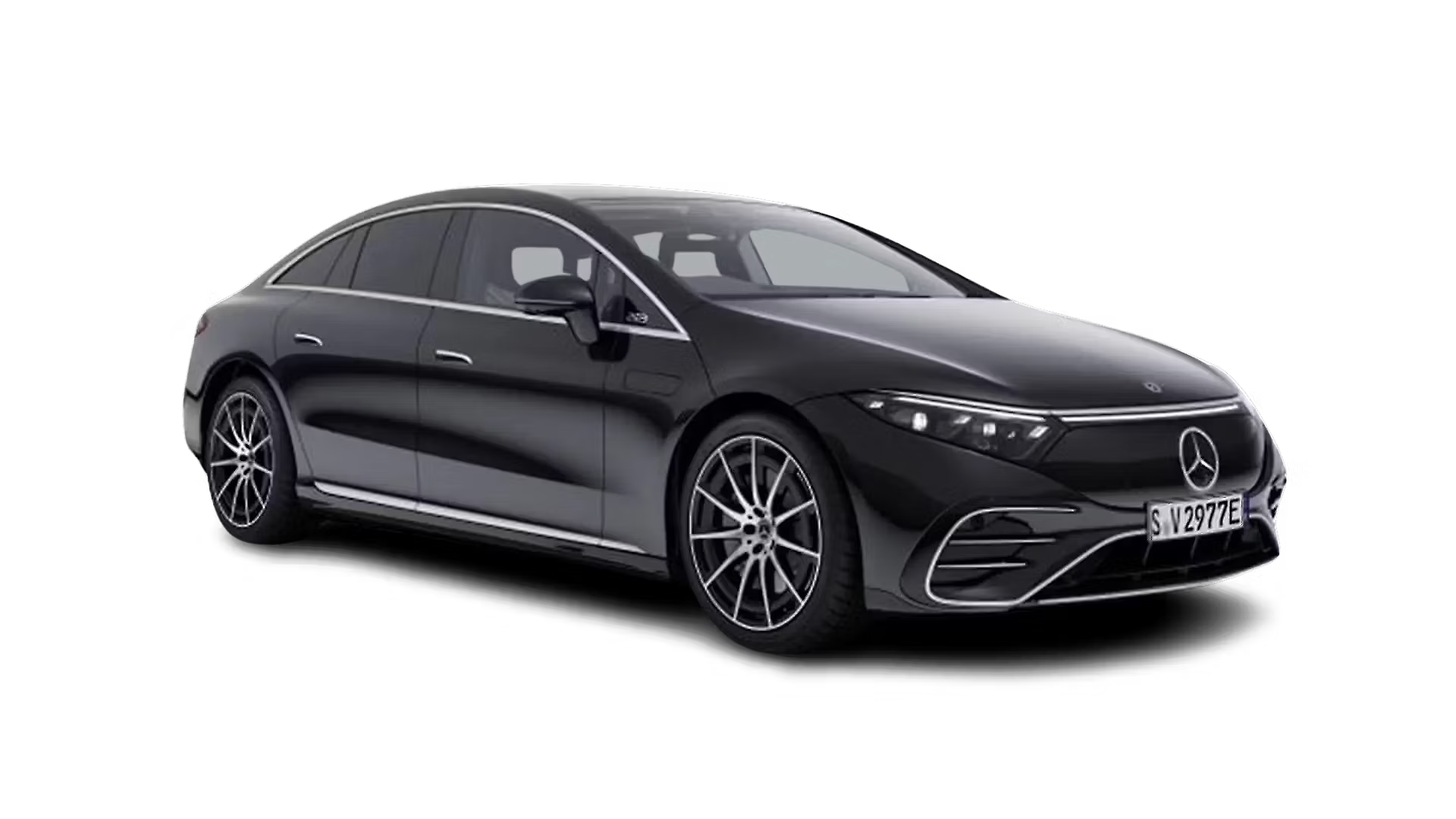
EQS Sedan | 1.30 to 1.48 Cr | 107.8 kWh | 813 to 857 km (ARAI) | 536 bhp | Available |
EQS SUV | 1.33 to 1.48 Cr | 122 kWh | 809 to 820 km (ARAI) | 355 to 536 bhp | Available |
G 580 with EQ Technology | 3.10 Cr | 116 kWh | 473 km (WLTP) | 579 bhp | Available |
₹1.48 crore buys either the EQS Sedan 580 4Matic (857 km ARAI) or the EQS SUV 580 4MATIC (809 km ARAI). Same money, two very different ways to carry four adults.
A note on that ₹1.20 Cr EQE Sedan price: it's an industry estimate, not an official figure. Mercedes-Benz India hasn't confirmed pricing or a launch window yet. Treat it as directional until the company announces dates.
EVSoch Reality Check: don't buy on the range figure alone
Every range number in that table, WLTP or ARAI, is measured in lab conditions: no AC, gentle acceleration, controlled temperature. None of that describes a Mumbai summer commute or a Delhi winter highway run with the cabin at 22°C and four adults aboard.
For a heavy, all-wheel-drive luxury EV like the EQS SUV (2,845 kg kerb weight), real-world range in Indian city-and-highway mixed driving with AC running typically lands at 65 to 75% of the ARAI figure, so an 809 km ARAI rating realistically delivers somewhere around 530 to 590 km in daily use. The EQS Sedan, being lighter and more aerodynamic (0.20 Cd), holds up a little better, but still expect meaningfully less than 857 km once you're driving it like a car and not a lab test.
This isn't a Mercedes-specific problem; it applies to every EV on this list. But at this price point, buyers deserve to know the number on the windshield sticker isn't the number they'll see on a Tuesday commute.
EQ nameplate confusion: EQE Sedan is not the only EQE
If you're researching “Mercedes EQE India,” you'll run into two different cars:
● EQE Sedan: the model this guide covers. Still upcoming in India, no confirmed price or launch date as of August 2026.
● EQE SUV: a separate model that was on sale in India from September 2023 (₹1.41 Cr) but was discontinued in April 2026 along with the EQA and EQB, as Mercedes-Benz shifted its India strategy toward higher-margin, top-end luxury rather than entry-level EVs.
If a dealer or a classifieds listing says “EQE” without specifying body style, confirm which one before you get excited about a price or a spec.
EQS Sedan: the range king
Launched in India in August 2022 as the electric S-Class, the EQS Sedan pairs a 107.8 kWh battery with twin motors making 536 bhp and 858 Nm in all-wheel drive. The 580 4Matic carries an ARAI-claimed 857 km range, the longest of any EV sold in India. A limited Celebration Edition (50 units) offers 813 km at a lower ₹1.30 Cr, against the 4Matic's ₹1.48 Cr.
0-100 km/h takes 4.3 seconds, top speed is 210 km/h, and a 200 kW DC charger takes it from 10-80% in about 31 minutes. A 22 kW home wallbox needs roughly 5.5 hours for the same top-up. The compromises: 110 mm ground clearance (a concern on broken Indian roads and speed breakers), a 610-litre boot, and 2,585 kg kerb weight. Cabin highlights are the 56-inch MBUX Hyperscreen, Burmester 3D audio, nine airbags, and Level 2 ADAS.
EQS SUV: the family flagship
Launched September 2024, the EQS SUV fixes the sedan's two biggest practical issues: ground clearance jumps to 220 mm, and the 580 4MATIC seats seven (the 450 4MATIC is a five-seater). Both share the 122 kWh pack, with ARAI range of 820 km (450) and 809 km (580).
Power ranges from 355 bhp/800 Nm on the 450 (0-100 in 6.1s) to 536 bhp/858 Nm on the 580 (4.7s). Both charge 10-80% in ~31 minutes on a 200 kW DC charger, or ~6.25 hours on a 22 kW wallbox. Price: ₹1.33 to 1.48 Cr. The standout is the 10-year, unlimited-km battery warranty, genuinely reassuring at this price point, since a battery replacement outside warranty on a 122 kWh pack would be ruinous. It's heavier than the sedan at 2,845 kg, and the third row is best reserved for children.
EQE Sedan: the wait-and-see option
The smaller, upcoming sibling, expected around ₹1.20 Cr in a single EQE 350 rear-wheel-drive variant, though Mercedes-Benz India has not announced a launch date. On paper: 90.6 kWh pack, claimed 639 km WLTP range, 292 PS/565 Nm rear motor, 0-100 km/h in ~6.4s, 210 km/h top speed. DC fast charging is 32 minutes (10-80%) at 170 kW; an 11 kW wallbox is bundled for home charging.
Its 430-litre boot and 105 mm ground clearance make it the least practical body in the EQ range, but it's also the lightest at 2,355 kg, with a 10-year/2,50,000 km battery warranty and a 5-star Euro NCAP score. Treat every figure here as provisional until Indian pricing and ARAI numbers are officially confirmed: global spec sheets and India-spec figures often differ.
EQA and EQB: gone, but still findable
Both compact luxury crossovers were discontinued in April 2026. Mercedes-Benz confirmed existing stock had sold out and the brand is now prioritising higher-margin, top-end models over entry-level EVs. The only way to buy one now is dealer leftover stock or the used market.
The EQA 250 Plus (launched July 2024) ran ₹67.20 lakh with a 70.5 kWh pack, 560 km WLTP, 188 bhp and a 340-litre boot. The EQB was India's only seven-seat luxury EV: the 250 Plus and 300 4MATIC both offered three rows, priced ₹72.20 to 78.90 lakh, with range from 423 km (300 4MATIC) to 535 km (250 Plus) on 66.5 or 70.5 kWh packs. Both cap out at 160 km/h and charge up to 100 kW DC (10-80% in ~32-35 minutes).
If badge and a seven-seat row matter more than the newest tech, a clean used EQB, with its 8-year unlimited-km battery warranty still intact, is a defensible pick over waiting for something new.
G 580 with EQ Technology: the outlier
At ₹3.10 crore, the G 580 is the most expensive and most distinctive car in this line-up. Launched 9 January 2025, it pairs a 116 kWh battery with four motors, one per wheel, making 579 bhp and a colossal 1,164 Nm. The WLTP range of 473 km is the shortest here, explained by a 3,085 kg kerb weight, but it does 0-100 km/h in 4.7 seconds, retains 250 mm ground clearance, and can execute a 360-degree tank turn. Charging: 32 minutes (10-80%) at 200 kW DC, or 11.7 hours on an 11 kW wallbox.
EVSoch Cost Breakdown: what does charging one of these actually cost?
Assumptions (August 2026, adjust for your DISCOM and provider): home AC charging at ₹9/unit (typical higher-slab residential tariff in a metro like Mumbai); public DC fast charging at an indicative ₹21/unit. Actual rates vary by state, discom slab, and charge point operator; check your electricity bill and the charging app before budgeting precisely.
EQS SUV 580 (122 kWh pack), full home charge:
● Energy cost: 122 kWh × ₹9 = ₹1,098 per full charge
● Cost per km at claimed 809 km range: ~₹1.36/km
● Cost per km at realistic ~560 km range (see Reality Check above): ~₹1.96/km
Monthly running cost, 1,500 km/month, charged almost entirely at home:
● Energy needed at practical efficiency: ~327 kWh
● Cost: 327 kWh × ₹9 ≈ ₹2,940/month
Compare that to a petrol-powered Mercedes S-Class doing the same 1,500 km at a realistic ~7 km/litre and ₹100/litre petrol: roughly ₹21,400/month in fuel alone, over 7x the EQS SUV's home-charging cost. Even accounting for the EV's much higher upfront price, the running-cost gap is the strongest financial argument for going electric at this level, not the purchase price.
A highway top-up on a public DC charger (10-80%, ~85 kWh added) costs roughly ₹1,785 at the assumed ₹21/unit rate, worth knowing before a long weekend drive if you're used to thinking of “charging” as a home-only, near-free habit.
Real-World Example: a Mumbai to Lonavla weekend run
A Mumbai-based EQS SUV 580 owner doing daily office commutes (~35 km/day, charged overnight at home) plus a fortnightly Lonavla weekend trip (~180 km round trip via the expressway) would use roughly:
● Weekday driving: 35 km × 22 days ≈ 770 km/month, fully covered by overnight home charging. No public charging needed at all.
● The Lonavla round trip (180 km) comfortably fits within the ~560 km realistic single-charge range even with AC on, meaning no highway charging stop is required for that specific trip, a genuine convenience the range figure, even discounted for real-world driving, does deliver.
This is the scenario where the EQS SUV's huge battery earns its keep. It's not about maximum range on paper; it's about never having to think about charging on routes under ~500 km.
Who Should Buy
● Buyers with guaranteed home or bungalow charging (wallbox-capable parking, not shared apartment infrastructure)
● Anyone cross-shopping against a petrol S-Class or 7-Series who values dramatically lower running costs over the ownership period
● Buyers who mostly drive intra-city or single-charge-range highway routes (Mumbai to Pune, Delhi to Chandigarh) rather than doing multiple back-to-back long-distance runs
Who Should Avoid
● Apartment dwellers without dedicated, sanctioned EV charging points: a 122 kWh battery is only an asset if you can reliably plug it in overnight
● Buyers wanting the EQA, EQB, or EQE SUV specifically: none of these three are available new in India any more
● Anyone budgeting on the ARAI/WLTP number as a real-world guarantee, especially for AC-heavy, traffic-heavy city use
Questions to Ask the Dealer
● Is the EQE Sedan's India launch date confirmed yet, or still an estimate? (Get this in writing if it affects your purchase timing.)
● What's the battery degradation warranty in writing: years, kilometres, and minimum retained capacity, not just “10 years unlimited km”?
● Does Mercedes-Benz India or an empanelled partner install the home wallbox, and is that cost included in the on-road price?
● What's the nearest authorised EQ service centre, and does it stock high-voltage battery components locally or import them on demand?
● How is insurance IDV calculated on a car this expensive, and what add-on covers (zero depreciation, battery protection) are recommended?
The bottom line
The Mercedes EQ range in India is really two ranges: the EQS Sedan and SUV for buyers who want the biggest battery and longest range money can buy, and the G 580 for buyers who want the G-Wagen silhouette with zero tailpipe emissions. The EQE Sedan, when it finally lands, will slot in between, but there's no confirmed date yet, so don't delay a purchase decision waiting for it. The EQA and EQB are gone from Mercedes-Benz's India price list entirely; the used market is now the only route to either.
Match the model to your charging routine first, and to the badge second. That discipline, not the horsepower figure, is what will keep you from ₹3-crore buyer's regret.