
Electric Vehicle Charging Basics: Everything You Need to Know to Power Up
Stepping into the world of electric vehicles is an exciting milestone. Whether you recently parked a brand-new EV in your driveway or you are just exploring the idea, one of the first transitions you will make is shifting your mindset from refueling to charging.
Think of charging an EV a lot like charging your smartphone. You do not always wait for it to hit zero; instead, you top it up wherever it sits, whether that is at home overnight, while you are at work, or during a quick stop on a road trip.
To help you navigate this electric transition smoothly, let us break down the fundamentals of EV charging, the different speed levels, and how to make the most of your battery.
1. The Three Levels of EV Charging
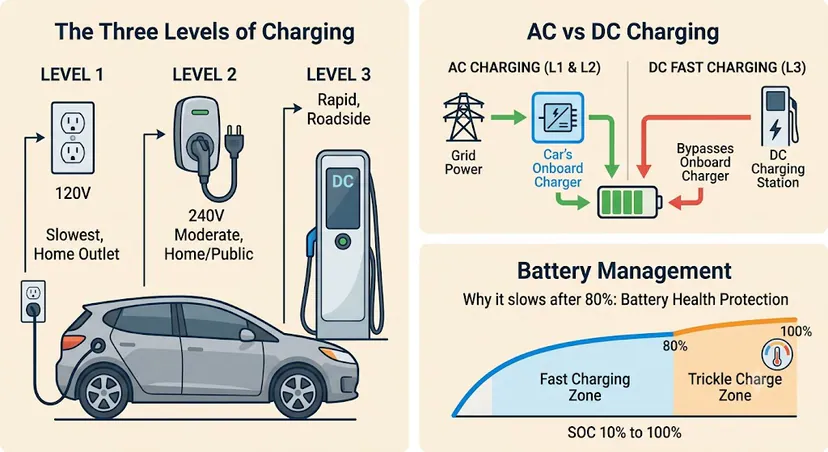
Not all chargers are created equal. EV charging is generally categorized into three distinct levels based on voltage, power delivery, and speed.
Level 1 Charging (Standard Wall Outlet)
The Setup: Uses a standard 120-volt household outlet. Every EV comes with a portable cordset that lets you plug right into a regular wall socket.
Speed: Adds roughly 3 to 5 miles of range per hour.
Best Used For: Emergency backup, plug-in hybrids, or drivers with very short daily commutes who can leave their car plugged in overnight for long stretches.
Level 2 Charging (Home and Public Stations)
The Setup: Uses a 208-to-240-volt circuit, which is the same kind of heavy-duty outlet used for electric clothes dryers. These can be professionally installed in your garage or found across commercial public networks.
Speed: Delivers about 15 to 40+ miles of range per hour.
Best Used For: Everyday home charging and workplace parking. A Level 2 charger can comfortably refill a depleted battery overnight.
Level 3 DC Fast Charging (On-the-Go Power)
The Setup: High-voltage commercial stations that deliver Direct Current straight to your car battery.
Speed: Can take many modern EVs from 10% to 80% in roughly 30 minutes.
Best Used For: Road trips, long-distance travel, or drivers who live in apartments and lack access to home charging.
2. AC vs. DC: Why Fast Charging is Different
If you look closely at how Level 1 and Level 2 work compared to DC Fast Charging, you will notice a fundamental difference in electrical current:
AC Charging (Levels 1 and 2): The power coming from the grid is Alternating Current, but EV batteries store energy as Direct Current. With AC charging, the electricity passes through your car onboard charger, which converts the power before it hits the battery.
DC Fast Charging: The conversion from AC to DC happens inside the charging station itself rather than inside your car. By bypassing the vehicle onboard charger, massive amounts of power can be pumped directly into the battery pack, resulting in rapid charging speeds.
3. Why Does Charging Slow Down Past 80%?
Have you ever noticed that your EV charges blazing fast at first, but crawls to a finish line as it gets full? This is not a glitch, but rather a vital safety feature.
Charging a battery generates heat. To protect battery health and longevity, your vehicle Battery Management System automatically throttles the charging speed as the battery cells fill up and warm up. For this reason, on road trips, it is often faster overall to unplug around 80% and get back on the road rather than waiting for that final 20% to trickle in.
4. Quick Tips for Smooth Public Charging
Know Your Connectors: Depending on your EV make and model, you may use different connector types (such as CCS, CHAdeMO, or NACS). Always double-check that you are selecting the right plug.
Embrace Automated Tech: Networks are making charging simpler than ever. Programs like Autocharge+ let eligible vehicles plug in and start charging instantly without needing to tap an app or swipe a card.
Avoid Adapter Mistakes: Never force an unauthorized or AC adapter into a DC fast-charging port. Doing so can risk severe damage to your vehicle and the charging equipment.